

- Introduction
- Can your magic system influence the economy?
- Organization
- Writing Exercise: Economic World-Building
- Conclusion
Introduction
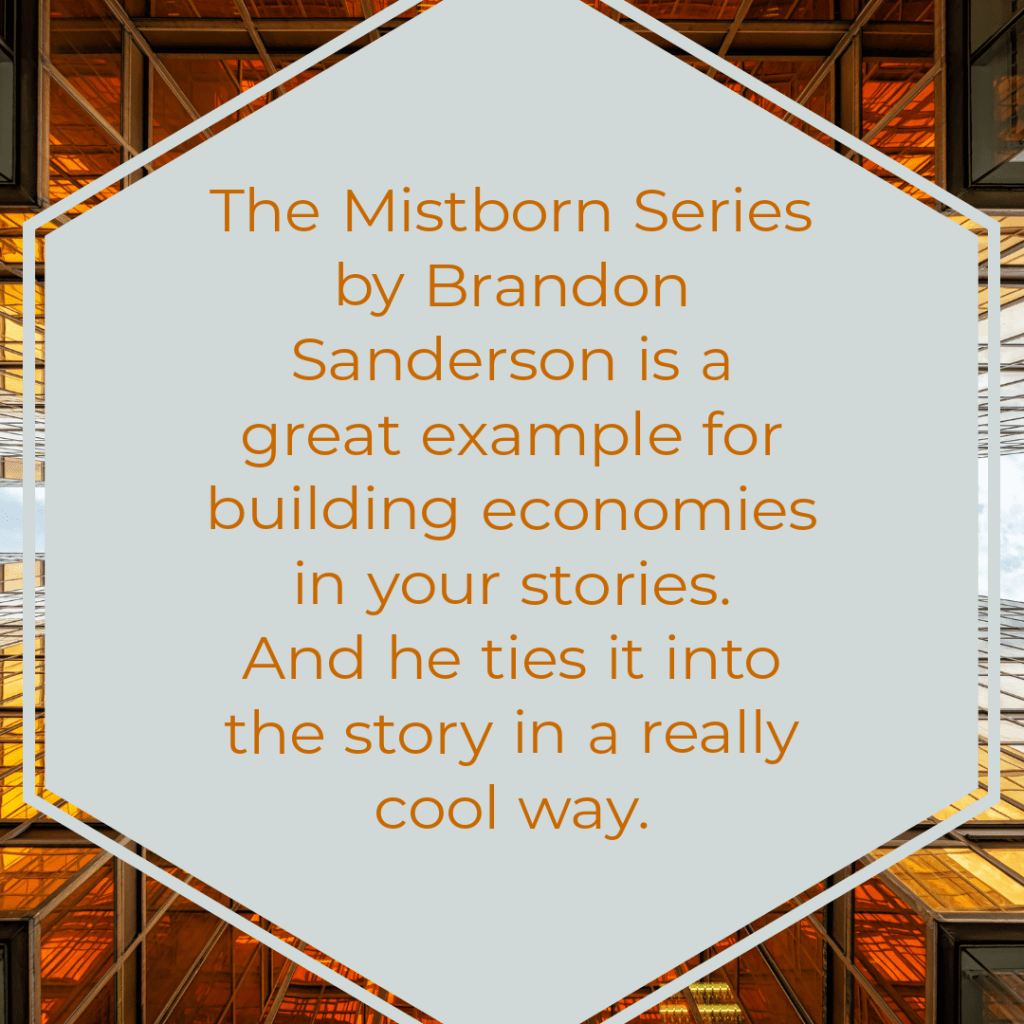
The economic variable from the PMESII-PT encompasses the individual and group behavior that is related to production, distribution, and consumption of resources. Let’s look at the Mistborn Series by Brandon Sanderson for this aspect. If you haven’t read this storyline, it’s a fantasy storyline about a young girl who is luckier than most, living on the streets of the Final Empire. Soon, she finds her luck gets her into more trouble than she can handle. The magic system in this storyline plays a big part in the economy.
Can your magic system influence the economy?
In this magic system, the user must “burn” metals, such as zinc, pewter, and iron, in order to use the “powers.” So how do the individuals and groups behaviors reflect on their resources? There are your common levels of wealth, the poor, middle class(working folk), Upper class (the lords of the great houses), and the Lord Ruler (King, essentially). Power is gained and maintained through atium, the rarest of metals. Not everyone can use the metals, so those who can be avoided, hired, or sought for death. Most can only use one metal, those are often hired by the great houses for defense. Very few can use all metals, and those are called Mistborn. They are kept within the “royal bloodlines” and away from the lower classes. This keeps the people who can use atium under the Lord Ruler’s control. The Lord Ruler controls the dispersal of atium and manages the great houses of the realm.
Consider these Questions
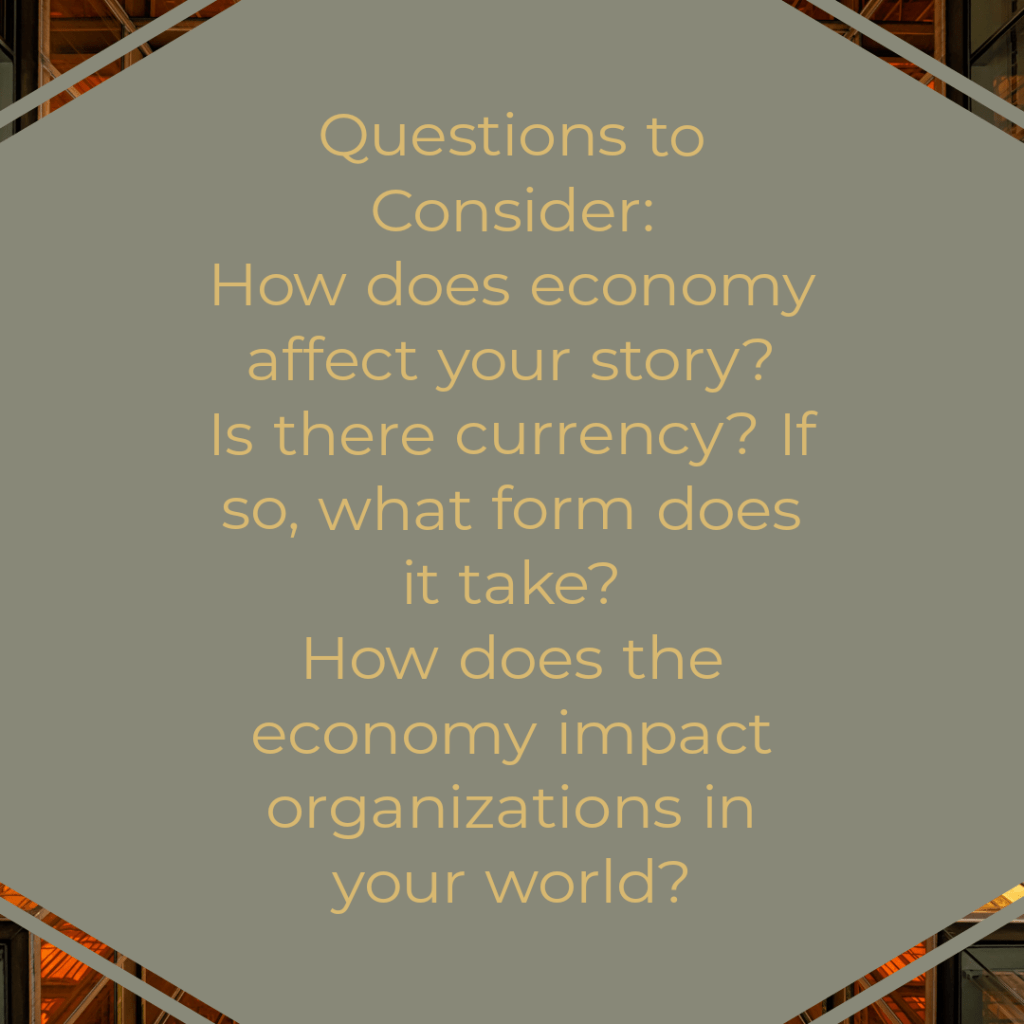
So how can you use this for writing? A lot of information, right? Well, this is the depth you need to create an economy. Even if you look at non-fictional economies, it goes beyond the dollar, euro, or peso. So if you’re using currency, what gives that currency value? Is it like the silver dollar that is supposed to be worth a dollar of silver of its life cycle? Or is it based on need? Does your community trade for goods have a communal dispersal system? Also, look beyond money. How do you get your resources to the civilization or nomadic tribe you’ve constructed?
With those questions in mind, let’s visit the next step in economy, organization.
Organization
It affects industrial organizations, international trade, foreign aid, the rule of law, and financial management. The control of the atium isn’t the only source of income, but it drives the wages towards those who have the metal. A Boxing, or the imperial gold coin used as currency or can be used by Mistborns or Coinshots (find the various kinds of Mistings here). People at all class levels use the boxings, but they are paid up the chain toward sources of atium. The reason metals play a part in the organization and trade area is that of the Steel Inquisitors, Mistborns, that essentially control the government. One of these days I may do a deep dive analysis into the Mistborn world, but I don’t want to get too many TLDR comments on this post.
Consider these Questions
What can you do for your story to integrate this concept? First, look at your resources and the industries required to mine, manufacture, or grow those items. Also, do certain regions have unique resources? Or does the community build, grow, and self-sustain? What’s your currency system and who manages it? Do your people trade with far-away lands, or in local markets? Are there taxes? How does your government, council, oligarchy make their decisions? These are just some questions to get you thinking about your economy.
Writing Exercise: Economic World-Building
Create a unique economic system for a fictional world, focusing on how a magical or technological element influences the economy.
- Step 1: Magic/Technology Foundation
- Invent a magical ability or advanced technology that has the potential to impact your world’s economy. Describe its basic function and limitations.
- Step 2: Resource Management
- List 3-5 key resources in your world, including your magical/technological element.
Explain how these resources are produced, distributed, and consumed.
Determine which groups control these resources and why.
- List 3-5 key resources in your world, including your magical/technological element.
- Step 3: Social Structure
- Create at least three distinct social classes in your society. Describe how access to your magic/technology affects their economic status.
- Step 4: Currency and Trade
- Design a currency system. Is it based on a precious material, magical essence, or something else?
Outline basic trade practices within your world. Consider both local and long-distance trade.
Explain how your magic/technology influences trade and currency value.
- Design a currency system. Is it based on a precious material, magical essence, or something else?
- Step 5: Economic Organizations
- Create 2-3 major economic entities (e.g., guilds, corporations, government bodies).
- Describe their roles in managing resources, trade, and the magic/technology.
- Step 6: Laws and Regulations
- Develop 3-5 key economic laws or regulations that govern the use of resources and magic/technology in your world.
- Step 7: Conflict and Plot Hooks
- Based on your economic system, brainstorm 2-3 potential conflicts or plot hooks that could drive a story in this world.
- Final Task: Write a brief scene (300-500 words) that showcases an economic interaction in your world, highlighting how your magic/technology influences the exchange.
Remember, you don’t need to explain every detail to the reader. Focus on making the essential elements clear and interesting.
Conclusion
Every world is different and the same. You will always find parallels to the real world, ancient civilizations, or mythologies. The goal here is to create a system that works for your world, and then using it to help your story. Or just use it for your knowledge. You don’t need to write out every detail for the reader. As long as they can understand the essentials to make sense, then you’ll keep from overburdening the reader with unnecessary explanation. Note, every story requires a unique level of explanation. You decide as the author, because not every reader will be satisfied.
PMESII-PT Part 2 The Military Variable
Discover more from Kenneth W. Myers
Subscribe to get the latest posts sent to your email.
 Kenneth W. Myers
Pingback: Writing Tips: Using PMESII-PT Part 4: Social – Myers Fiction
Pingback: Using PMESII-PT in Fiction Part 2: The Military Variable – Myers Fiction
Pingback: World-Building Closeout – Myers Fiction