Essential Information
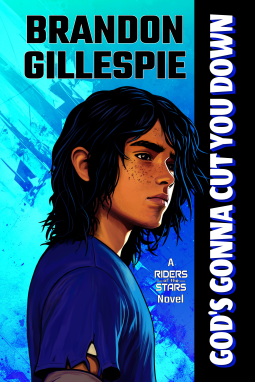
- Title: God’s Gonna Cut You Down: A Dystopian Retro-Future Adventure
- Author: Brandon Gillespie
- Genre: Young Adult Sci-Fi
- Publication Date: September 2025
- Length: 440 pages
- Format: eBook
- Publisher: Revenant Creative Studio
First Impressions
Ever since Atom Bomb Baby, one of the main things that draws me to Brandon Gillespie’s books has been the magnificent book covers. The art style and quality are amazing and really help build the vibe for the story. Gillespie reached out to me for a review and offered an ARC of God’s Gonna Cut You Down. I agreed to read this story because I enjoyed Atom Bomb Baby and the universe Gillespie is creating. With the vibes of Fallout from the first book, I was curious to see how Gillespie continued to make this story universe uniquely his.
I was warned that this wasn’t a sequel but a side story, so I wanted to give you the same heads up. Diego’s story of banishment after being falsely accused of a crime on an orbital space station really captured my imagination. With the strange and terrifying creatures down on the world, I could only imagine the ones that would appear in space.
Synopsis
Sometimes, being an outsider can make you interesting or feared. For Diego, always being marked by the void, it’s the latter. Before Diego can realize it, the adults in his community are in a power struggle, and he’s pulled into the conflict. God’s Gonna Cut You Down follows Diego as he fights to survive in the lower rings of the Serenity Orbital.
Delta Ring is home to the coldness of space, minimal life support, and a semi-mindless army of growlers. Diego, at least, has an advantage in dealing with the creatures touched by or embraced by the void. The first step is to survive. While survival is the major conflict, Diego doesn’t see the isolation as the greatest challenge. Where the challenges begin is when others appear. Exiled by their own people, and each a 14-year-old boy. But is that the true reason for their exile? They’ll only discover the truth if they can survive and find a way back up to Bravo Ring.
Critical Analysis
Narrative Craft
Brandon Gillespie’s writing style and voice help create a cinematic reading experience. He uses minor world-building details to add depth to the environments he builds, whether it’s a planet or a space orbital. God’s Gonna Cut You Down continues in this vein, using the layout of Serenity Orbital’s floors to tell stories beyond the main narrative. These side stories surface in brief clips, but rather than distracting from the central plot, they enrich it. They reveal Gillespie’s broader vision. He sees the full scope of the world, even when the novel zooms in on a single storyline. It’s this layering that gives Serenity Orbital its lived-in feel.
The pacing in God’s Gonna Cut You Down is especially well executed, considering that much of the early story centers on an isolated character. Maintaining momentum in scenes of solitude is no easy feat—dialogue is sparse, interaction limited, and conflict often environmental. Yet Gillespie keeps the reader engaged through careful modulation. Just when the narrative risks slowing, he introduces another character, adding the dynamic shift the story needs. His approach to pacing relies on a steady trickle of world-building details, reserving heavier exposition for moments that truly warrant it.
If you’ve read Atom Bomb Baby, you already know Gillespie’s knack for immersive world-building. In Serenity Orbital, that strength returns, this time anchored by the opening artwork, which immediately sets the tone. As in Atom Bomb Baby, Gillespie uses visual elements to lock in the reader’s sense of space, grounding abstract descriptions in concrete imagery. The depiction of the orbital helps orient us within its layered rings, making character movement and spatial dynamics easy to follow.
Then come the void creatures—unsettling, evocative, and central to the tension. Gillespie gives us a visceral sense of what happens when these entities go unmanaged, and how their presence distorts the lives of those untouched by the void. La Familia adds another layer, deepening the world-building through its social structures and implicit controls. Together, these elements reveal not just the world Diego inhabits, but the forces that shaped it, and the ones he must confront.
It’s also worth remembering that God’s Gonna Cut You Down is a young adult novel. At times, the dialogue and character interactions make you forget this, as Diego and the other boys hover on the cusp of adulthood before snapping back to their true age. Diego’s development stands out more than the others, highlighting how the people around us shape who we are, often more than we realize. This feels especially relevant for a YA audience, who are navigating those very dynamics in real time. I occasionally had to remind myself that I wasn’t the target demographic, though the dialogue and character choices still resonated with my own memories of youth.
Thematic Depth
God’s Gonna Cut You Down explores themes of depression and isolation with care and intention. Gillespie opens the novel with a letter to readers, acknowledging the presence of these themes. The letter is open, welcoming, and encouraging, an act of compassion that not only supports readers who may be navigating similar feelings, but also sets the emotional tone for what follows.
Each character reflects a different facet of depression. Diego, in particular, wrestles with the pain of being an outsider and the emotional weight of disfigurement. Gillespie captures how depression reshapes the way people interpret interactions, how even kindness can trigger suspicion or discomfort in someone who’s lived with emotional wounds for a long time. It’s a subtle but powerful observation: good intentions don’t always bridge the gap when someone’s internal experience is shaped by trauma.
Isolation is another theme Gillespie handles with nuance. Early in the story, Diego faces the stark loneliness of physical separation, classic survival territory, but made more poignant by his youth, when social connection is especially vital. As the story progresses, isolation takes on new forms. There’s the disconnection that comes from being near someone who may not be a true ally, where presence doesn’t guarantee trust. And later, Diego experiences isolation within a group, a more complex kind of alienation that speaks to the difficulty of belonging. I won’t spoil the details, but it’s clear Gillespie has a strong grasp on how layered and pervasive isolation can be.
Ultimately, God’s Gonna Cut You Down doesn’t just touch on these themes, it explores them with depth and empathy. Gillespie’s approach feels honest and grounded, making the emotional landscape as compelling as the physical one.
Character Analysis
The characters are the strongest element of God’s Gonna Cut You Down. As I read deeper into the book, I found that while the world-building was impressive, it was the characters who held my attention. I was team Diego from the start, and his arc delivered a genuinely rewarding experience.
Diego begins the story as a fourteen-year-old boy who’s lost both of his parents. In Bravo Ring, he’s seen as a bad luck omen and a potential growler. Growlers are something like zombies in space, but with a twist. They retain eerie, human-like traits and even speak cryptic warnings. Diego’s journey is a classic transformational arc, one that allows him to come to terms with who he is while battling depression and isolation. Gillespie develops Diego through both past and present challenges, crafting a protagonist who faces antagonists on multiple levels, both external and internal.
Raphael, or Rafe, is a compelling antagonist. He’s the kind of character you hate, then maybe start to understand, only to end up disliking again. Gillespie includes scenes from Raphael’s perspective, which helped explain his motivations and how he came to lead the Desteraddos. (Side note: the construction of this cult-like group was masterfully executed.) That said, I think Rafe’s arc might have hit harder if we’d discovered his betrayal solely through Diego’s eyes. Seeing everything unfold from Rafe’s perspective softened some of the impact. His arc is clearly a destruction arc, and by the end, there’s little left to redeem. He’s not a character you walk away liking, but he’s one you remember.
Impact and Significance
I enjoyed God’s Gonna Cut You Down both as a side story to the Riders of the Stars universe and as a stand alone novel. The themes are timely for the young adult audience and even gave me a great sense of closure at the end of the book. God’s Gonna Cut You Down guides readers through a challenging topic and brings them out the other side feeling like they’ve worked through some things. One of my favorite parts from God’s Gonna Cut You Down shows a strong representation of how constant emotional damage can affect people, especially young adults:
“The icy fear tangled inside him with something sharper, darker-a rising fire he couldn’t fully understand. It burned with the urge to throttle Raphael, to wring every thought of Donna out of him, mingled with an overwhelming desire to run and hide.”
Reader’s Guide
Target Audience God’s Gonna Cut You Down is primarily aimed at young adult readers, particularly those aged 14-18 who are navigating their own struggles with identity, belonging, and mental health. The protagonist Diego’s age and challenges will resonate strongly with teens who feel like outsiders or are dealing with depression and isolation. However, adult readers who appreciate character-driven science fiction with emotional depth will also find value in Gillespie’s thoughtful exploration of these themes. The book works especially well for readers who enjoy stories where survival isn’t just about physical challenges, but emotional and psychological ones as well.
Required Background Knowledge While God’s Gonna Cut You Down is set in Gillespie’s Riders of the Stars universe, no prior reading is required. As mentioned, this is a side story rather than a sequel to Atom Bomb Baby, so newcomers can jump in without feeling lost. That said, readers familiar with Atom Bomb Baby will appreciate the continued world-building and may catch subtle references that enhance the experience. The author does an excellent job of establishing the world and its rules organically through the narrative.
Content Warnings Gillespie thoughtfully includes a letter to readers acknowledging the book’s exploration of depression and isolation themes. The story deals with mental health struggles, feelings of worthlessness, and suicidal ideation in age-appropriate ways. There’s violence involving the void creatures (growlers), some disturbing imagery related to these zombie-like entities, and themes of abandonment and betrayal. The content is handled with care and ultimately offers hope, but sensitive readers should be prepared for emotionally challenging material.
Similar Authors or Books to Compare Readers who enjoy God’s Gonna Cut You Down might appreciate works by Pierce Brown (Red Rising series) for the space setting and coming-of-age elements, or Suzanne Collins (The Hunger Games) for survival themes with young protagonists.
Rating Breakdown
Score each aspect out of 5:
- Writing Quality: ★★★★☆
- Plot/Development: ★★★★☆
- Character/Argument Strength: ★★★★☆
- Pacing: ★★★★☆
- Innovation: ★★★★☆
- Overall: ★★★★☆
Final Verdict
God’s Gonna Cut You Down succeeds brilliantly as both an entry point to Gillespie’s universe and a standalone exploration of depression and resilience. The book’s greatest strength lies in its authentic portrayal of mental health struggles through Diego’s journey. Gillespie doesn’t offer simple solutions or miraculous recoveries. Instead, he presents a realistic path through darkness that feels both hopeful and earned. The world-building remains consistently impressive, with Serenity Orbital feeling like a lived-in space where every detail serves the larger narrative.
The character development, particularly Diego’s transformational arc, anchors the entire story. While Raphael’s perspective occasionally softened the impact of his betrayal, the complexity added to his character ultimately strengthens the story’s examination of how people respond differently to trauma and isolation. The pacing expertly balances moments of solitude with character interaction, never allowing the story to stagnate despite its isolated setting.
Minor weaknesses include occasional dialogue that reminded me this was YA fiction, though this hardly detracts from the overall impact. The themes are handled with remarkable maturity and care, making this essential reading for young adults struggling with similar issues, while remaining accessible to adult readers who appreciate thoughtful science fiction.
I’d specifically recommend this to teens who feel like outsiders, adults who work with young people, and anyone seeking science fiction that prioritizes emotional truth alongside imaginative world-building. God’s Gonna Cut You Down proves that YA science fiction can tackle serious themes without sacrificing hope or adventure, delivering a story that lingers long after the final page.
Previous Book Review: Drops of Glass
Discover more from Kenneth W. Myers
Subscribe to get the latest posts sent to your email.
 Kenneth W. Myers